Gender diversity across corporate leadership has drastically improved in recent years. However, the pace of change remains slower than desired. Altrata’s Global Gender Diversity 2024 report sheds light on this issue, focusing on female representation within corporate boards and C-suite positions across the Global 20. While there are reasons to be optimistic, the journey towards gender parity is far from over.

Slow progress or diversity stagnation?
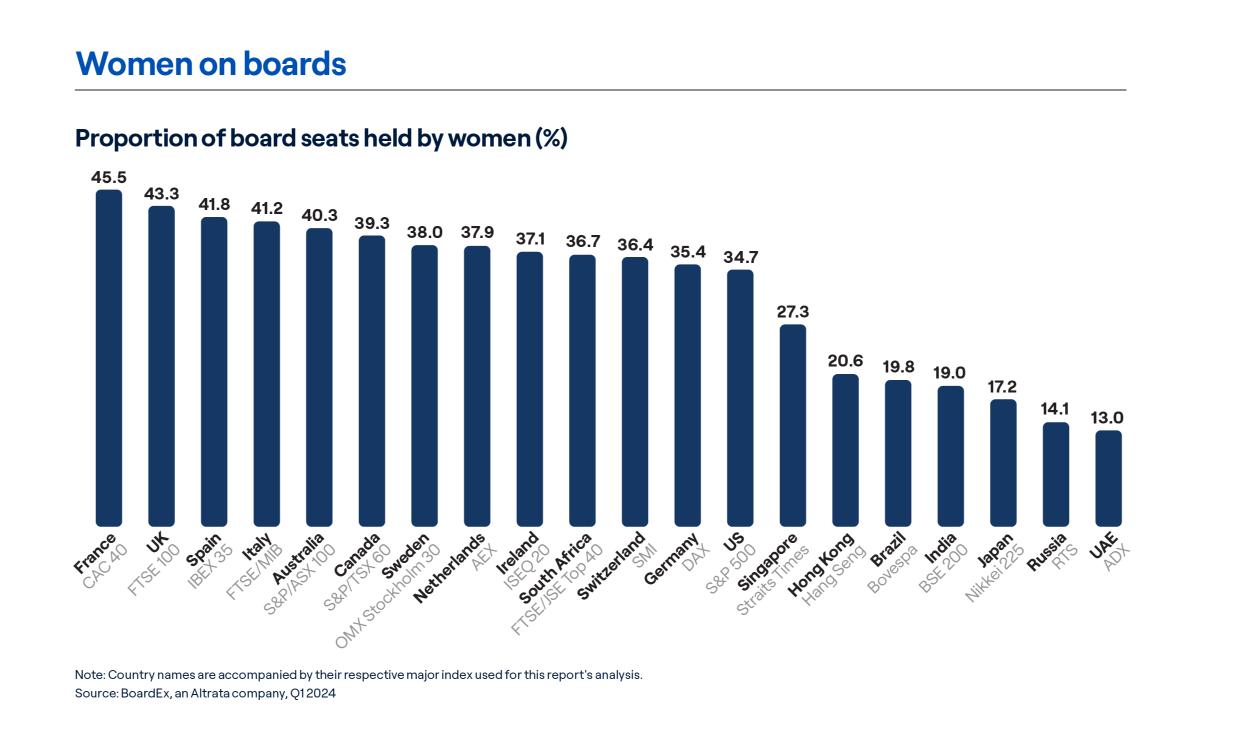
Looking at the first quarter of this year (2024), women hold 32% of board positions in major corporations. Year over year, it’s a clear improvement and continues to show that progress toward gender parity is certainly being made. France, in particular, stands out from the crowd, with 45.5% of board seats in CAC 40 companies held by women. The UK follows closely, with 43.3%, followed by Spain and Australia, who officially crossed the 40% threshold for the first time. The United States still ranks somewhat low on a global scale (13th), showing that there isn’t unilateral global progress, even across related Western markets. Regardless, Altrata’s report reveals a consistent upward trend in female board membership in all 20 countries examined since 2014. However, it stresses that achieving gender parity remains an elusive goal. If the improvement rate continues, it will take until 2034 to reach gender parity in the boardrooms of large, listed companies. Gender parity wouldn’t be reached until 2061 among executive director roles, such as the CEO and executive chair. Although progress is undeniable, it will still be decades before actual representation goals are officially met.
 What is driving this change?
There are a few factors driving the gradual shift in gender diversity. At a grassroots level, societal pressure has played a key role, both in company expectations and in the expectations of employees looking to advance. In France and Spain, for insurance, quotas have been implemented to mandate female representation on boards. Additionally, corporate culture has slowly started to recognize an idea that humankind has known forever: women make incredible leaders. The post-pandemic workplace seems to have had something to do with this, as flexible work structures and hybrid models have enabled women to pursue executive roles like never before. While these new roles and workplace flexibility have seen a boon of women pursuing these roles, there are still clear cultural resistances and structural improvements that stand in the way. In the US, a lack of mandated quotas and no real aggressive action seem to result in a sluggishness to close the gender gap, especially at the topmost levels of leadership.

An executive bottleneck
Moving up the executive ladder and away from boards, we can see a distinct falloff regarding the presence of women. C-suite positions held by women are significantly behind boardroom positions, with only 22% of leadership roles in the Global 20 being occupied by women, around a 10% gap. This reveals one of the bottleneck locations clearly: the move from board roles to senior executive leadership. Making the bottleneck even more distinct, only 6.5% of Global 20 CEOs are women. While the glass ceiling may have been raised, it clearly has not been shattered.

Cultural sluggishness: lagging female leadership by country
Despite incremental progress in many regions, certain countries continue to lag significantly in gender diversity, particularly in leadership roles. Russia and the UAE remain at the bottom, with female board representation at just 14.1% and 13%, respectively. These figures starkly contrast with leaders like France and the UK, highlighting how entrenched cultural norms and lack of regulatory enforcement contribute to slow progress.

A path towards future equity
While significant progress has been made in improving gender diversity across corporate leadership, there is still a long way to go. The Global Gender Diversity 2024 report makes it clear that achieving true gender parity will require sustained efforts from corporations, governments, and society at large. Legislative action, corporate accountability, and cultural shifts are all crucial elements in creating an environment where women have equal opportunities to succeed. As we move forward, these combined efforts will help pave the way toward a more equitable and inclusive future in leadership.

Article edited by Manuel Bianchi
Altrata Senior Vice President