The simultaneous presentation of two M&A transactions, which are very different from each other in form, enlivened the weekend. Between Sunday and Monday, Banco BPM proposed a ‘merger of equals’ transaction to Banca Monte dei Paschi di Siena to arrive at a merger that includes the companies recently acquired by each bank, Anima and Mediobanca. A few hours later, Intesa SanPaolo instead proposed a takeover bid to Banca Monte Paschi di Siena with a premium of 12.5%: 10.091 euros per share, a share consideration of 1.6 shares of Intesa SanPaolo, and a cash component of one euro for each share of the MPS. In total, a €30.6bn operation. In combination, BPER, currently involved in the incorporation of Banca Popolare di Sondrio, is also engaged in the acquisition of more than 600 branches that would be exceeded by ISPs the limits of antitrust rules legislation.
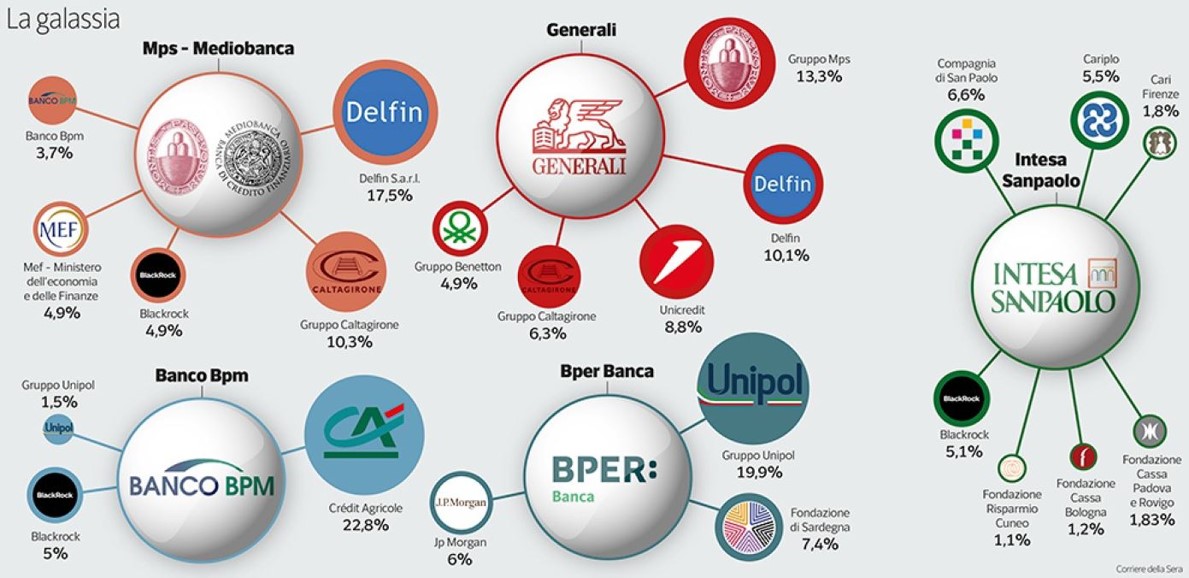
In both transactions, a matryoshka pattern is objectively evident as MPS contains Mediobanca, which, in turn, contains 13.3% of Generali. It is easy to assume that the latter position represents the founding objective of both choices. Generali is in a technically passive position, but it has shareholders, assets under management and market weight to generate various influences in the phase in which the operations will have to unravel. It should be emphasised that all mergers and acquisitions in the banking system of the European Union are subject to the consent of the European Central Bank, which has two Italian members in the Steering Committee, Cipollone and Panetta, who involve the main Italian insurance companies – Unipol, Intesa SanPaolo and Generali – and several financial intermediaries of the most varied nature subject to the consequences of the final result.

Two other banks are indirectly affected by the outcome:
- Unicredit, absent in the current risk, but a growing shareholder of Generali and engaged in the difficult but consolidated acquisition of Commerzbank, with the only significant transnational transaction underway in recent years; in the case of ISP as the winner, there would be an interesting cohabitation in Generali which would reproduce, in completely different scenarios, the historical coexistence throughout the second half of the twentieth century of Banca Commerciale and Credito Italiano in Mediobanca with Enrico Cuccia dominant position as CEO;
- Credit Agricole, a significant shareholder of 22.8% of Banco BPM, present in Italy with Credit Agricole Italia, but excluded in the case of success of ISP’s OPVS; in the opposite case, it would assume the most influential position in the second Italian banking company just after ISP, an element that could implement, with many doubts and cautions, the exercise of the Golden Power in the hands of the MEF with an undesired intervention of the Government.

Let’s try to outline some evaluations about the different hypotheses, trying to remain, as fair as possible and as less subjective as possible, except for a personal expression of consensus regarding the proposal to change the structure of the system with a view to the weight of Italian banking groups in the European Union: something very new in the landscape of financial and banking markets.
- the recipient object is always the same, i.e. MPS in its new enlarged version and in both cases, while retaining its trademark, it would lose in its brand the reference with Siena after 553 years when it was created in 1473 as a pawnbroker, a psychologically relevant element at least in the traditional territory in which the bank originated; paradoxically, it has not suffered the effects of its own serious crisis during the period between 1913 and 2023 and would come to abandon its autonomy and independence despite a rehabilitated reputation and generating flows and profits capacity;
- the shareholders of MPS, which are partly the same as those of Generali and Unicredit, must choose between the exchange of their shares with Banco BPM through the merger of equals with dilution of the percentages or the acquisition of them by ISP (net of the part paid in shares of the latter) at the above mentioned price that could be subjected to a rise during the bargaining;
- the markets reacted, as early as Monday 8, with significant rises for MPS and Generali, limited declines for ISP and stability for Banco BPM; ISP then recovered on Tuesday with further rises for MPS and Generali;
- the timing of the two offers was fully compliant with the rules in force, presented with the markets closed; it seems more interesting to underline the fact that both, with a technical structure that is still complex and complete, were presented a few hours apart, indicating the hypothesis that they were already ready previously and – maybe – known one each other;
- the advantages for the shareholders of the target bank are different; the position of Blackrock present in all three entities with de facto equal shares of 5% is singular; moreover, in Generali and Unicredit, the two parties indirectly involved, there are shareholders who have shares in MPS, Unipol has a 1.5% stake in BPM, while ISP has 5 of the 6 first shareholders ex-banking Foundations, absent elsewhere; BPM is already a 3.8% shareholder of MPS;
- all active and passive subjects are listed, with hundreds of thousands of small shareholders not always small in fact, who will not weigh in the decisions of the shareholders’ meeting, but who must be protected in accordance with the Italian Consolidated Codes and UE Directives;
- the overall picture is objectively complicated to monitor, not excluding any of the main national banking operators; the case of BPM appears delicate which, if it achieves its objective, becomes a primary bank in Italy as it would lose relevance otherwise, recoverable only in part if the shareholder Credit Agricole increases its role and incorporates the Italian structure already existing and, for some time, among the top ten Italian banks;
- in any case there will be problems of integration, selection and potential conflict to be resolved; just think of Unipol-Generali and Fideuram ISP, Mediobanca Premier and Widiba in the ISP/BPER transaction and the numerous outsourcing to be resolved in the BPM case; much more complex will be the issue of asset management and private and wealth management, certainly the objective of ISP move, but also, in a different form, of BPM, the only reality without off-site distribution companies and related financial planners;
- more equal, but delicate and problematic is the issue of overlapping counters and personnel redundancies, especially in the central structures, which are very abundant and, obviously, with various duplications of role;
- since the difficulties of implementing mergers are well known, it should be remembered that MPS is committed to accelerating the merger with Mediobanca, while BPER is in the process of integrating with Banca Popolare di Sondrio; especially the IT and technological aspects are critical in these cases and result in a complex trade-off between organizational and IT alignment costs and choices in terms of branches and personnel;
- careful assessments will be necessary regarding the necessary capital increases, use of reserves and free capital accumulated over the years and maintenance in perspective of capital requirements, which are currently more than satisfactory for all actors as standing alone;
- The ISP-BPER/Unipol hypothesis would rein in MPS in the passivity rule, depriving it of any defensive move, without prejudice to the behavior of the shareholders present in several positions including, it should be emphasized, also in the opposite BPM/MPS transaction;
- all shareholders will be diluted in the BPM/MPS case: in the current situation, which may not be the same at the time of the final choices, in MPS, Delfin would go from 17% to 9.8%; Caltagirone from 10.2% to 5.8%; the Blackrock funds, in both institutions, will remain at 5%; the 3.7% of Bpm in MPS, on the other hand, will be cancelled; the ISP/MPS case is different, as the overlaps are minimal, on non-significant shares, except for the indirect role that shareholders who are also in Generali as well as in MPS can play;
- with regard to the position of the MEF, as a shareholder in MPS, it would decrease to 2% in the BPM case and could sell or remain in the ISP case; technically it would still be the final step in fulfilling its role for the initial bail-out in the past years, but it remains to consider the weight of the very different political choices even within the parliamentary coalitions themselves;
- Generali will in any case act both with its governance and as choices of the individual shareholders; we recall that Delfin – Leonardo Del Vecchio Holding – is in all these company books except in Unipol/BPER and that in MPS it is the first shareholder and in Generali the second, bearing in mind the internal problems related to the management of its founder’s inheritance;
- last, but not least, there is the point of view of customers who, after the conclusion, will suffer the effects, positive or negative, of the change; notoriously, at the beginning, the impact will be dangerous, an excellent opportunity for the numerous small and minor banks if they demonstrate efficiency towards classic savers, retail and affluent investors and smaller and minimal companies, all very high potential in their mass for the stabilization of assets under management, even for the largest banks.

As on all occasions, there are two final considerations to be proposed, aware of not having addressed all the problems:
- on this occasion it will certainly be the market that decides the solution, if both continue on their own path; whoever loses will have to manage the consequences;
- the positive effects described in the project maps will be subjected the feedback of the new operations and, as in any marriage, only after the merger will outline the final outcome.

Article edited by Prof. Giuseppe G. Santorsola
Chair in Asset Management,
Corporate Finance and Corporate & Investment Banking
Catholic University of Holy Heart, Piacenza