The recent US-EU summit (20 October 2023) was organized to review the main transatlantic partnerships and investigate any potential areas of collaboration. In recent years, the well-known dependence between these two important economies has been confirmed by the latest economic crises and remarkable fluctuations in US macroeconomic variables (e.g., subprime mortgages).

Looking at the past, the multiplicative effect of the quantitative easing policies adopted by the FED to contrast the recession was triggered by the decrease in interest rates and by huge money injections operated by the FED (2008-Mach 2010, May 2010-November 2011 and September 2012- October 2014). This contributed to dramatically increasing the quantity of currency available at low prices, with the main consequence of increasing the demand and price of bonds and shares (financial inflation). In addition, the FED policy of purchasing secondary treasury bonds triggered a substantial liquidity increase for banks and investors, with a decrease in their price increases and returns. On the other hand, Europe started to operate with a similar strategy of decreasing interest rates to avoid an increase in its currency value and the consequent deterioration of its Trade Balance.

During the pandemic, the US and EU governments increased their public debt, leveraging on the low/negative market rates, and distributed to citizens and businesses substantial bonuses and subsidies. After the Covid emergency, the demand for goods and services rocketed thanks to these bonuses and savings accumulated during the lockdown. This contributed to the economic recovery but also created inflation, further accentuated by the rising energy costs (due to the war in Ukraine). Inflation was also triggered by the post-COVID supply chain bottlenecks that convinced the FED and the BCE to adopt several drastic measures, like increasing the interest rates and tightening their monetary policies.

With high-interest rates, the USD became strong, especially thanks to investors’ increasing demand for USD. Despite its late reaction, the BCE and the deposit and loan rates increased in front of this increasing inflation. This triggered a consequent increase in businesses and citizens’ new bond and loan rates. The increase of the bond interest rates created the accumulation of latent capital losses in banks, insurance companies and private investors’ portfolios, due to the impossibility to disinvest them. This happened in particular for the German bunds, sold in the past at negative rates.
In the last months, characterized by high-interest rates and an accentuated recession for many European countries (e.g. Germany), the quantity of currency in circulation started to decrease thanks to tight policies adopted by the banks. While the US government can keep under control the scenario thanks to its strong economy (e.g. high flexibility of its labour market), the EU economy is struggling: Germany, the strongest EU country, has already reduced its GDP forecast. Finally, with the energy market crisis (war in Ukraine) and with the increase in the value for the USD, the situation of the raw material market has dramatically penalized the EU countries.

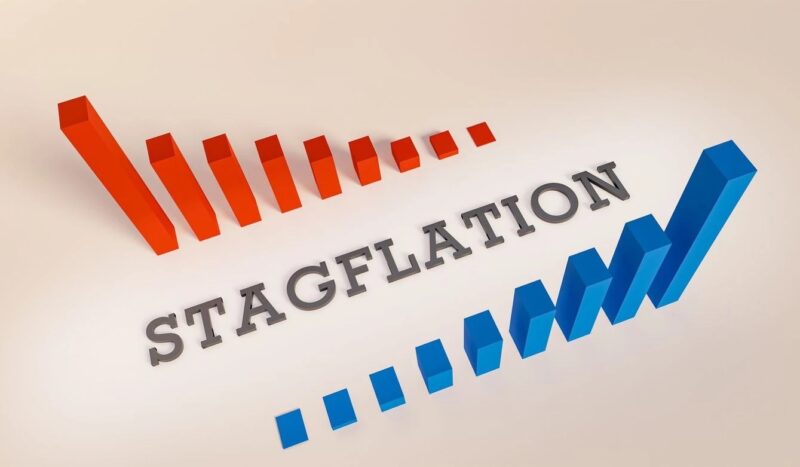
One of the biggest concerns for most economists and financial investors is that the measures adopted to contrast inflation won’t lead to a “soft landing scenario”. In other words, a heavy recession or stagflation could compromise the intensity and timing of the economic cycle recovery. In this situation, the dynamics of the labour and financial markets would deserve further analysis to understand the current stagflation scenario described fully.

Article edited by Prof. Paolo Bongarzoni
Dean Swiss School of Management and Corporate Director