Football teams are currently under the alarm of the supervisory authority: 94% of clubs are loss-making. Are we on the verge of a financial disaster because of unsustainability? Is it only the tip of the iceberg that will overwhelm other European football Leagues? Despite revenues having grown thirty-fold since 1992, especially English clubs are unable to meet the costs and depend on shareholder support to stay afloat. Premier League debt is over €4.4bn. Similar problems are growing in Ligue1, Liga, Lega-Serie A and Bundesliga. We will analyze mainly Premier League, but we will take into account the other four. They are the gross richest clubs in the world, they are managed as corporations more than football associations, but 94% of them are at a structural loss. They attract investment from funds and billionaires from all over the world, but depend on continuous shareholder recapitalizations, without which two-thirds of companies could survive no more than 90 days. English football is “on the brink of a financial disaster”, is the conclusion of the Independent Football Regulator (IFR), the supervisory authority set up by the British government barely in 2025 to bring the budgets of Premier League, Championship and other three minor professional leagues under control.
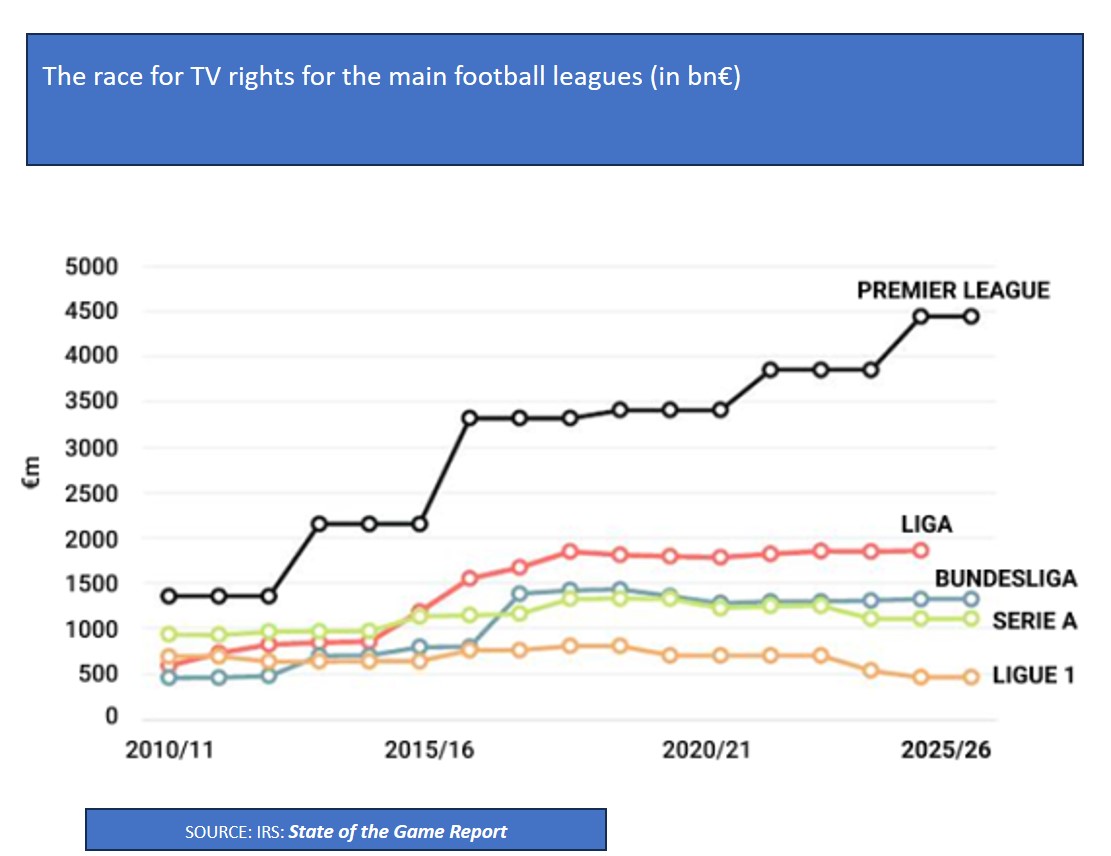
IFR published an analysis of the state of health of English football, the State of the Game Report, which will be the basis for a corrective plan to be compulsory implemented by 2030. The report, firstly, acknowledges the extraordinary growth of the movement, especially in the top league: since 1992 the average revenues of Premier League clubs have increased 30 times, at a rate ten times higher than the British GDP, the gross domestic product. The increase was mainly the result of the multiplication by 60 of the proceeds from the sale of television rights: in this context, by now, the Premier League plays a league of its own compared to the other European’s ones (see graph below) thanks to the popularity of its matches not only – and not so much – at home as on international markets. Every expense is possible thanks to television rights and sponsor’s fees cash flows, mainly, sovereign fund, digital and technological companies and new finance enterprises.
The interest of fans from all over the world was soon joined by that of foreign capital who saw English football clubs and other UE Leagues teams as an investment opportunity. In the last five years, therefore, transactions worth 7.2bn£ (about 8.5bn€) have been concluded, which have led to changes in the shareholding structure for 65% of Premier League companies. Suffice it to think, to stay with the most recent transactions, of the entry into Liverpool of a consortium led by the Mittal family of Indian steelworkers and participated by the founder of Amazon, Jeff Bezos, and the co-founder of Facebook, Eduardo Saverin. The interest of these and other deep-pocketed investors has brought, the IFR estimates, the total value of Premier League clubs to 12.5bn€, more than double that of other European leagues. The new owners have not skimped on spending to make their teams more competitive in the domestic league and, above all, in the highly rich European tournaments, starting with the Champions League. In the 2025/2026 season alone, Premier League clubs bought players for 3.1bn£ (3.7bn€) and sold them for 1.25bn€, with a negative balance of around 2.2bn€, 17% of this sum, moreover, went to remunerate agents who collected almost 650mn€ in commissions last season. It was not only the cost of sport cards that exploded, but also the average salary of the players in the squads, often overpaid with longer contracts, which, in the last five years, has risen by 33% for the top clubs and to a greater extent in the lower leagues, where clubs battle to win a place in the coveted and very rich Premier League, but financially terrorized if they are relegated after few years. Other clubs prefer to remain where they are in order to avoid such a risk because of the combined impact of debts, losses and depreciations.
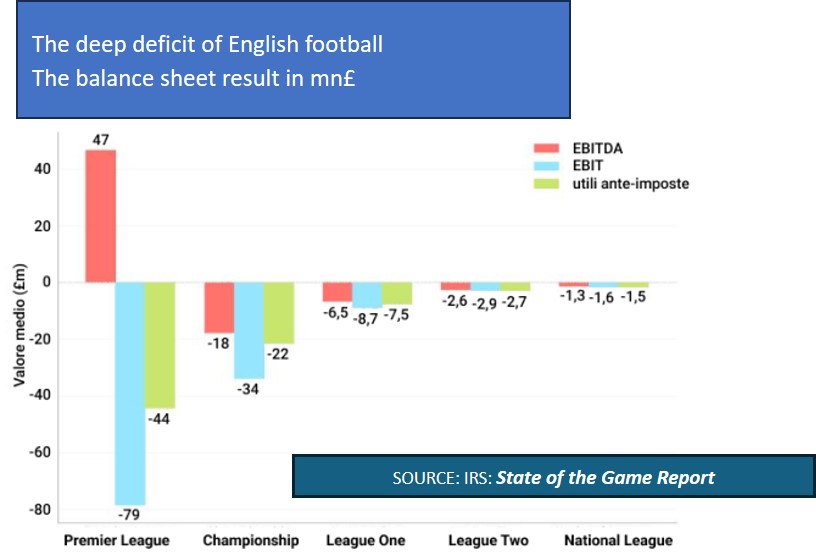
Indeed, the pharaonic expenses for the transfer market have doubled the cost of depreciation of cards in football, which went from 1.3 to 2.6 bn€ pounds (i.e. 3.1 bn€) between the 2021/22 and 2025/26 seasons. This item, combined with the boom in salaries, has effectively ended up eating the extraordinary increase in revenues from TV rights, merchandising and stadiums management. This explains the above mentioned fact that 94% of English football clubs are loss-making, as can be seen from the graph below: on average, for Premier League clubs, the red in their balance sheet is 44mln£ (52mln€) and figures are worsening.
The accumulation of deficits is forcing the owners to proceed with continuous recapitalizations, which are essential to pay salaries and keep the club solvent. Between March 2025 and March 2026, 67 English football clubs received many capital injections from their shareholders, sometime against the financial fair play rules and from sources that maybe must be investigated. But how long will this availability last? Between 2012/22 and 2025/26, the IFR notes, investors in the top five English leagues lost 41% of the original value of their investment, while the FTSE 100, the benchmark index of the London Stock Exchange, gained 38%. Unfortunately, most of current shareholders are not supporters of the club, but only third part investors, oriented to the return! The capital injections by the owners have not prevented a conspicuous recourse to debt by English clubs. In the last five seasons, their debt has risen from 2.8 bn€ to 4.1 bn€ pounds (4.9 bn€ euros) and this year, the IFR predicts, it will reach 5.1 bn£ (over 6 bn€ euros), 75% of which weigh on the budgets of Premier League clubs. And it is a burden that, with the increase in rates, risks becoming unsustainable: the interest on the debt paid annually by the clubs has increased in five years from 97 to 455mln£ (537mln€), an increase of 370%. The cost of debt therefore has quadrupled. What would happen if at some point one or more clubs were no longer able to cope with the repayment of this mountain of debts, especially bank debts? For the owners, the risk would be to lose control of the club at zero and, therefore, see the value of their huge investments cancelled. As can be seen from the table below the clubs have granted their creditors guarantees worth over 13.7bn£ (16.2bn€) to obtain financing: the pledges often insist on assets such as stadiums or future revenues from TV rights, but in many cases they weigh on the club’s own capital, exposing it to the same fate that befell in Italy Inter in the transfer of ownership between the Zhang family and Oaktree.
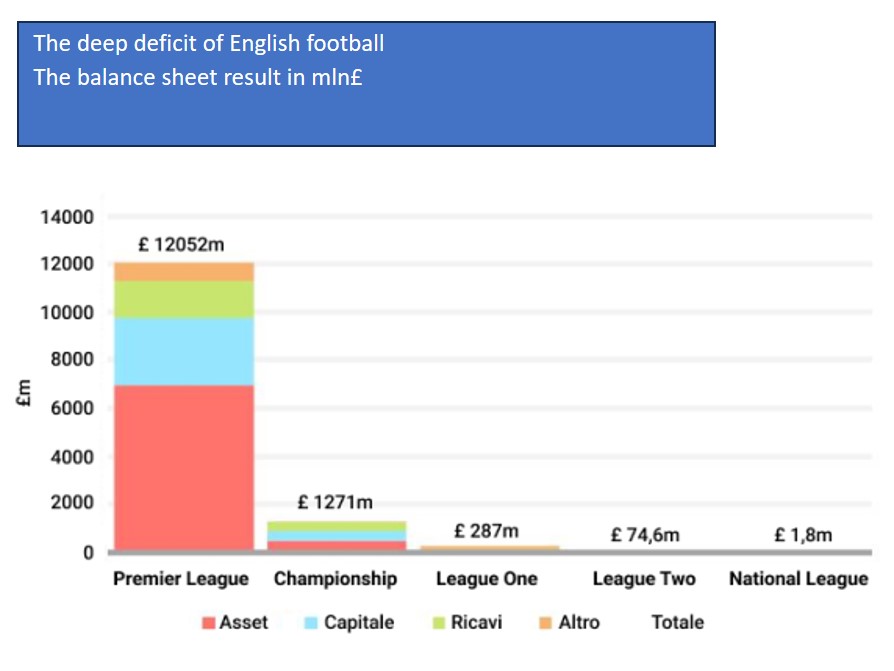
With these numbers, the IFR’s conclusion is merciless. “We cannot waste any more time without addressing the amount of financial risk that has become entrenched in English football”. If football fails, maybe it’s the end of an industry because of the lack of adequate and accepted control rules. Financial equilibrium is as important as the equilibrated position of the players on the field!
Article edited by GIUSEPPE G. SANTORSOLA
Senior Full Professor
Chair in Asset Management,
Corporate Finance and Corporate & Investment Banking.
Adjunct Professor of Finance
Catholic University of Holy Heart, Piacenza