The 2025 CIBJO Congress, held in Paris from October 27 to 29, marked a defining moment for the World Jewellery Confederation (CIBJO) as it entered its Centenary Year. Returning to the city where it was founded in 1926 as a pan-European body before becoming a truly global organisation in 1961, the Congress gathered more than 350 delegates and guests, with hundreds more joining online through a live stream. Hosted by the Union Française de la Bijouterie, Joaillerie, Orfèvrerie, des Pierres et des Perles (UFBJOP), the Paris event opened with welcoming remarks from Gaetano Cavalieri, CIBJO President, and Bernadette Pinet-Cuoq, Executive President of UFBJOP. The three days of discussions focused on sustainability, ethics, innovation, and global collaboration, themes that have long defined CIBJO’s mission.
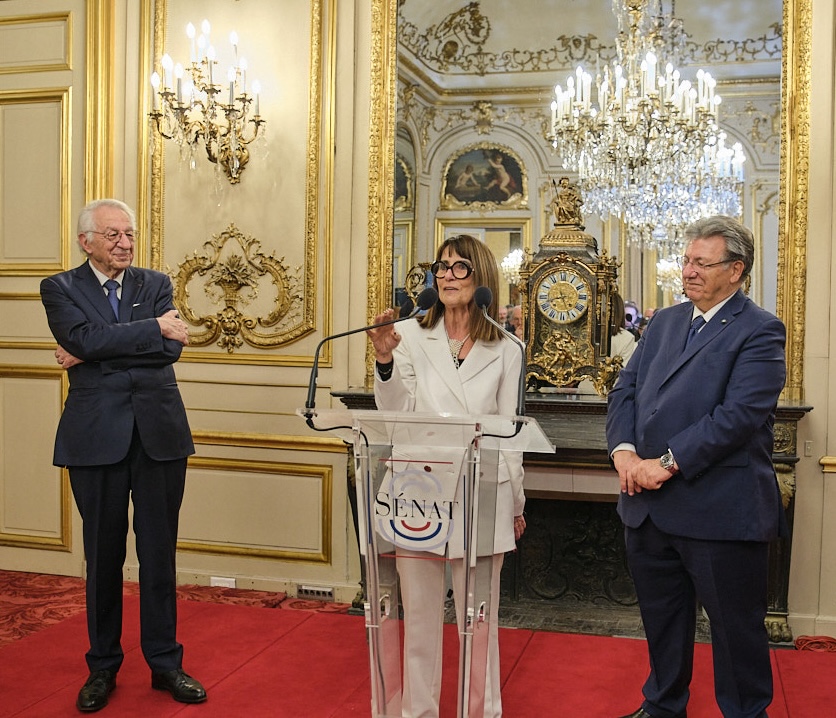
From left: Daniel Cambour, Bernadette Pinet-Cuoq and Gaetano Cavalieri
Key leaders from across the world highlighted the enduring bond between craftsmanship, responsibility, and creativity. Daniel Cambour, President of UFBJOP, celebrated France’s great artisanal tradition and called for a renewed commitment to excellence and innovation. Didier Roux, President of Francéclat, emphasised CIBJO’s crucial role in setting global benchmarks that ensure consumer trust. From the world of Haute Joaillerie, Cyrille Vigneron, Chairman of Culture and Philanthropy at Cartier, spoke of jewelry as “objects of love and emotion,” urging the industry to uphold ethical integrity and “scientific truth.” Marie-Claire Daveu, Chief Sustainability and Institutional Affairs Officer at Kering, reaffirmed that “sustainability is central to luxury,” calling for cooperation across generations to achieve genuine progress. Feriel Zerouki, President of the World Diamond Council, praised Dr. Cavalieri’s leadership in promoting transparency and values that remain timeless even in the digital era. Adding a creative and entrepreneurial perspective, Roberto Coin, internationally renowned jewelry designer and brand founder, participated in the discussions, reflecting on how artistry and responsible production can coexist, reinforcing the idea that beauty and ethics must evolve together.
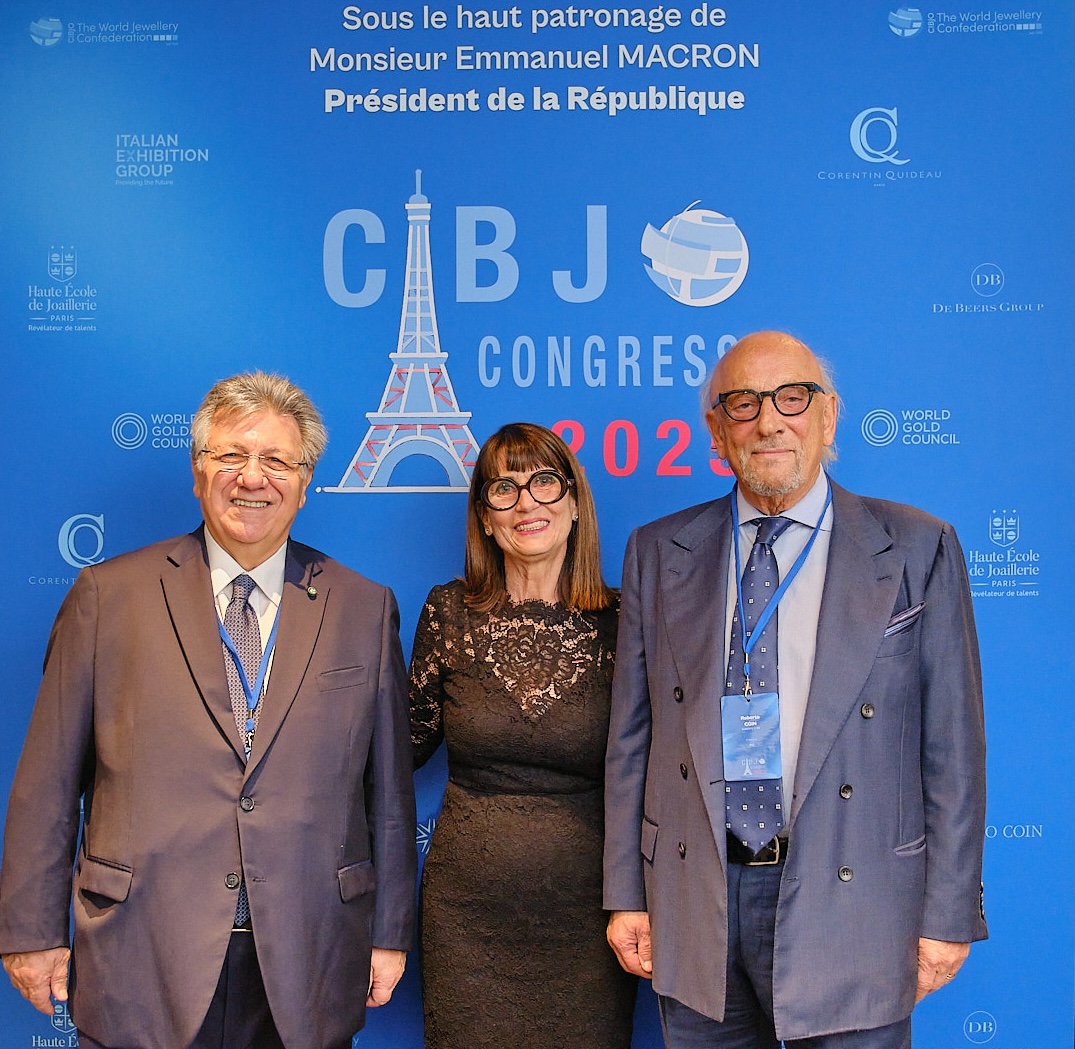
Gaetano Cavalieri, Bernadette Pinet-Cuoq, Roberto Coin
Beyond celebration, the Paris Congress also tackled pressing global issues, from the need for clear consumer communication about natural and synthetic diamonds to the effects of geopolitical pressures, sanctions, and shifting markets. Delegates discussed ESG compliance, traceability, and the need to harmonise sustainability frameworks worldwide. In line with its collaboration with ISO, CIBJO reaffirmed its position as the jewelry industry’s “parliament,” offering internationally recognised guidelines through its Blue Books and Blue List, which define transparent terminology and responsible marketing standards. In his keynote address, Cavalieri reflected on CIBJO’s remarkable journey, saying: “Ninety-nine years ago, in this very city, a group of jewelry industry leaders gathered to establish a forum in which they could discuss common issues. What these pioneers sought to do was to unite jewelers, beadmakers, and ornament manufacturers from multiple countries to promote craftsmanship and standards.”
As Maurizio Ermeti, Chairman of the Italian Exhibition Group (IEG), announced, the centenary celebration will continue in Vicenza in 2026, during the Vicenzaoro trade show, honouring a hundred years of shared values and progress. In her remarks, Bernadette Pinet-Cuoq thanked CIBJO for placing the nomenclature issue on the program. “In France, together with the Natural Diamond Council, we have taken a clear position on terminology,” she said. “The 2002 French decree defines a diamond as synthetic when it is man-made and, consequently, a diamond that is not man-made is natural. That is our linguistic standard, and the authorities have confirmed it. Through the Blue List, CIBJO provides the industry with clear guidelines on how to communicate about sustainability, offering accurate definitions for every claim related to business or product.”
She concluded that “the jewelry industry is magnificent because it embodies the strength of a collective that takes its destiny into its own hands, with two goals in mind: consumer confidence and a committed supply chain.”
That sense of unity also underpins Cavalieri’s personal vision. For him, being a bridge builder means linking not only markets but also cultures, philosophies, and people. CIBJO’s mission extends beyond standards; it is about connecting worlds through shared values, ensuring that jewelry continues to embody beauty, emotion, and ethical purpose.

Following the Paris Congress, we spoke with Cavalieri about his role as a bridge builder between markets and cultures, and about how CIBJO’s centenary marks both a moment of reflection and a roadmap for the future of the global jewelry industry.
“Today more than ever, being a bridge builder between nations, cultures, continents, and peoples is essential. Markets have no borders. There are mature, young, and emerging markets that differ in their production and consumption capacity. In the luxury and jewelry sector, which accompanies the most important moments of life—birth, religion, marriage, anniversaries—the value of a precious object is at once cultural, philosophical, and social. In India, for example, the bride presents herself at the wedding adorned with her jewels, a symbol not only of culture and religion but also of economic security for the family. In Africa or South America, the same principles apply: aesthetics, culture, religion, philosophy, and above all, sustainability, understood as what the family can embrace and what makes their dreams come true. Uniting people and cultures means respecting their differences so that everyone feels represented, and the jewel, regardless of its economic value, can mark moments of joy and emotion. Being a bridge builder today, in a world marked by contrasts and even wars, means bringing moments of joy that generate positive effects,” Cavalieri said.
During the Paris Congress, the African panel drew particular attention. How do you see Africa’s role evolving, not only as a source of materials, but as a creative and economic force shaping the future of the jewelry industry?
“Africa’s growing role in the jewelry sector extends far beyond being a source of raw materials. It is emerging as a creative, economic, and cultural force shaping the industry’s future. The African panel at the Paris Congress, with a special focus on African women, stemmed from CIBJO’s long-standing commitment to gender equality and empowerment. Through this initiative, CIBJO supported groups of aspiring female entrepreneurs across sub-Saharan Africa, providing them with tools, training, and structural support to develop their own businesses. These efforts led to the creation of the African Jewellery Association, for which CIBJO helped establish the statutes, compliance framework, and operational tools, and continues to assist its growth and professionalisation. The results of this collaboration were clearly visible during the Congress. CIBJO’s broader goal is to help African nations, endowed with extraordinary natural resources and craftsmanship, to build sustainable, value-adding industries, ensuring that prosperity remains within local communities. By promoting entrepreneurship, education, and fair economic development, CIBJO aims to foster a more inclusive and balanced global jewelry industry, where Africa plays a leading role not only as a supplier, but as a creator and innovator.”
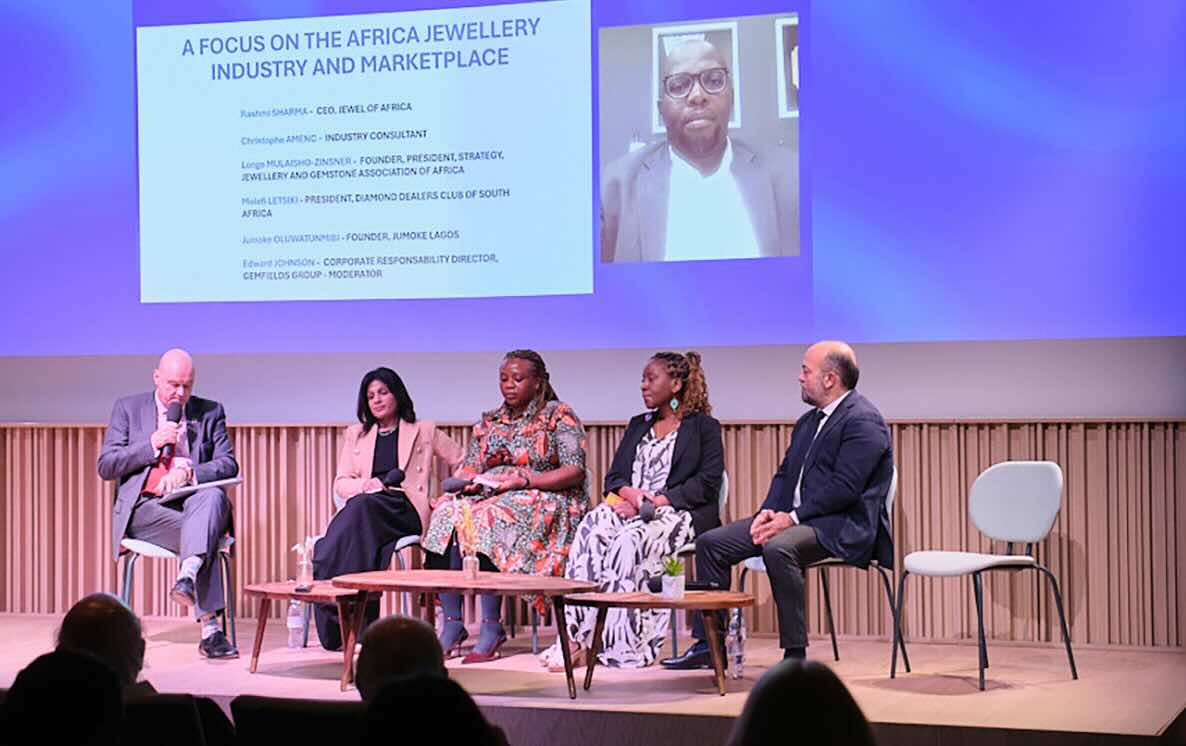
From left: Edward Johnson, Rashmi Sharma, Jumoke Oluwatunmibi, Longo Mulaisho-Zinsner, Christophe Amenc
The Paris Congress highlighted how artificial intelligence is transforming the jewelry industry, automating grading, improving efficiency, and even influencing design. Yet jewelry is above all a human art, built on emotion and craftsmanship. How can the industry embrace AI’s potential without losing the soul that makes jewelry meaningful?
“Artificial intelligence is undoubtedly transforming the jewelry industry, enhancing efficiency, grading accuracy, and even inspiring new design directions. Yet, as emphasised during the Paris Congress, jewelry remains above all a human art, rooted in creativity, emotion, and craftsmanship. In this sense, natural human intelligence will always be the foundation of jewelry, fashion, and luxury. Imagination, culture, and manual skill are human qualities that no machine can replace. However, we cannot ignore the benefits of AI. It is now part of every major global discussion, both public and private, and the jewelry sector must also learn to use it wisely. For CIBJO, the key principle is clear: AI must serve humanity, not the other way around. Used responsibly, it can assist design, production, and education, helping professionals work more efficiently and explore new creative horizons. But the soul of jewelry, the inspiration drawn from art, history, and human emotion, will always come from people. From the classical beauty of Giotto or Michelangelo to the expressive genius of Van Gogh or Gauguin, it is these cultural legacies that guide us in shaping the jewelry of the future. In short, AI should enhance craftsmanship, not replace it. It is a tool to elevate human artistry, ensuring that technology strengthens rather than diminishes the heart of the jewelry world.”
The creation of the International Fine Jewelry Academy in Milan, in collaboration with the Haute École de Joaillerie in Paris, represents a concrete step toward a new European vision for jewelry education. How will this project be realized in practical terms, and what role will CIBJO play in its development?
“The International Fine Jewelry Academy in Milan marks a concrete step toward a new European vision for jewelry education. Created by CIBJO, in partnership with Confcommercio Milano, Mani Intelligenti Foundation, and CAPAC, the Academy aims to preserve and transmit Italian artisanal excellence to new generations worldwide. The Academy is expected to open in early 2026. Its programs will combine technical training, design culture, and market knowledge, primarily through in-person teaching, with a later option for hybrid learning. Admission will be selective, based on merit and potential. A key feature is the involvement of retired master goldsmiths, who will pass on their craftsmanship to students from across the world, from India, Africa, China, and the United States, among others. An exchange agreement is being developed to promote cultural and technical collaboration between Italy and France, enhancing luxury education on both sides. CIBJO will play a guiding role by helping set educational standards, promoting the initiative internationally, and linking training to the global jewelry industry. Ultimately, the Academy aims to become an international centre of excellence, preparing a new generation of master jewelers who will carry forward the tradition and innovation of fine European jewelry.”
.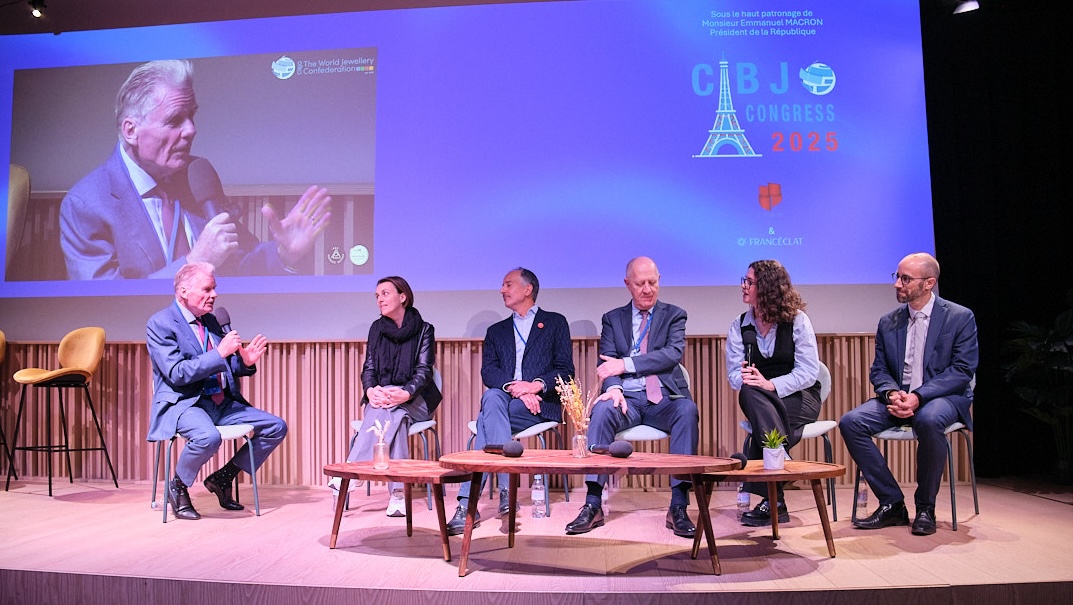
From left: Kenneth Scarratt, Alessia Crivelli, Olivier Segura, Michel Baldocchi, and Aurélien Delaunay
CIBJO was born in Paris one hundred years ago, and the Congress marked the opening of its Centenary Year. How will the organisation celebrate this important anniversary, and what can we expect from the next Congress?
“Throughout the coming year, a series of major international events will take place, from Paris to Vicenza, Munich, Hong Kong, and Las Vegas, concluding again in Vicenza in September next year. Each of these gatherings will focus on information, education, and consumer protection, which CIBJO considers essential to safeguarding and strengthening the jewelry industry as a whole. The organisation’s efforts are rooted in education, transparency, and ethical standards, following the principles set out in the CIBJO Blue Books and aligned with global frameworks such as the United Nations, the OECD, the UN Global Compact, and the World Trade Organisation. Collaboration with governments and institutions remains key to ensuring that the highest values of integrity and responsibility continue to guide the industry. As CIBJO celebrates over a century of activity, it remains committed to deep roots in tradition while growing rapidly toward the future, a vision that will culminate at the next CIBJO Congress in Vicenza, in September of next year.”
With its Centenary Year now underway, CIBJO invites the industry to its next initiatives: a continuing journey of unity, responsibility, and creativity.
Article edited by Laura Astrologo Porché
Instagram @journaldesbijoux