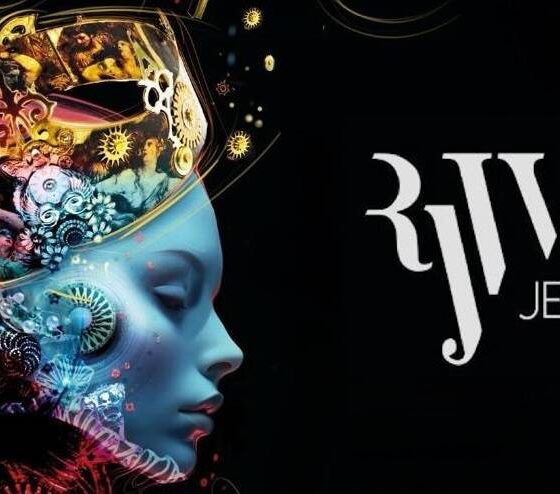
With “Codice RJW / Memoria Futura”, Sorrento becomes the setting for more than a retrospective on the first five years of Roma Jewelry Week (RJW). Presented at Villa Fiorentino from March 21 to May 3, 2026, the exhibition considers how contemporary jewelry in Italy has developed into a platform for research, cultural identity, and critical discourse.

Organised in collaboration with Fondazione Sorrento and Stylo Project, and curated by architect Monica Cecchini, the project brings together artists, jewelry designers, and master goldsmiths whose work has contributed to shaping the identity of Roma Jewelry Week since its launch in 2021. Rather than a traditional retrospective, Codice RJW / Memoria Futura is a living archive of the ideas, tensions, and exchanges that have shaped the event over five editions.

Hiromi Suter
The title Codice RJW refers to a language built over time through exhibitions, residencies, conversations, and collaborations. It expresses the shared visual and conceptual identity of the Roman event. Future Memory, meanwhile, suggests that memory is not fixed, but alive, something that can be reinterpreted, challenged, and projected forward.

Emanuele Leonardi

Matteo Vitali
Jewelry is seen not as an accessory, or only as craftsmanship, but as an independent form of expression. Materials, concept, technique, and cultural memory, all play a role, showing how contemporary jewelry is moving away from pure decoration and toward meaning. In this way, the exhibition reflects a wider international shift: the idea that jewelry can be a language, tell a story, and express a critical point of view.

Anna Pinzari

Antonio Fontana

Simone Cipolla
As part of Fondazione Sorrento’s Materia e Memoria program, the exhibition feels particularly fitting. Few disciplines can explore the relationship between intimacy and symbolism, body and culture, technique and imagination as effectively as jewelry. Roma Jewelry Week has consistently worked in that space, and the Sorrento exhibition makes the coherence of that vision visible. Looking back at the editions from 2021 to 2025, what emerges is not a series of separate events, but a project that has approached jewelry, year after year, as a space for connection, reflection, and transformation.

Cristina Perali
“We are thrilled and deeply grateful to Fondazione Sorrento and Attorney Gaetano Milano for making this exhibition possible, bringing the five-year journey of the Roma Jewelry Week project to Sorrento. This area, long committed to celebrating excellence in craftsmanship and the arts, will provide the ideal stage for a fruitful dialogue between Rome’s artistic excellence and local talent. This exchange will also come to life thanks to the collaboration with LAbout Sorrento and Stylo Project,” declared Monica Cecchini.

Luigina Rech
What stands out most is that RJW has become more than an annual event. It is now a cultural platform that connects makers, institutions, galleries, schools, trade associations, and curatorial projects. The exhibition brings this network into focus, showing how a shared curatorial vision can generate not only exhibitions, but also collaborations, new formats, and broader conversations that expand the role of jewelry in contemporary culture.

Alessio Boschi
A key role in shaping this vision is played by InCinque Open Art Monti, the Rome-based space where much of the original idea behind RJW began. More than a traditional gallery, it was conceived as a place for exchange among art, architecture, craftsmanship, and design. Over time, it became an important reference point for contemporary jewelry, especially through the Incinque Jewels residency project. This background explains the character of Roma Jewelry Week itself: its focus on process rather than display, on dialogue rather than simple presentation, and on building lasting cultural value rather than short-term visibility.
The presence of AUREA ROMA, the collective of Roman goldsmiths and designers, reflects one of the most interesting sides of RJW: its ability to connect Roman goldsmithing tradition with contemporary expression. The exhibition does not present heritage as something fixed or untouchable. Instead, it shows that tradition stays alive when it is used and reinterpreted in the present. In the work of these makers, the heritage of Roman craftsmanship becomes a living language open to change.

Riccardo Alfonsi

Forlenza
From this point of view, Codice RJW / Memoria Futura also says something important about Italian jewelry as a whole. For a long time, it has mainly been seen in two ways: as luxury or as heritage craftsmanship. Roma Jewelry Week, and this exhibition in particular, points to a third way. Jewelry can also be a cultural practice: thoughtful, refined in its materials, and engaged with the ideas of the present.

Angela Gentile
That position becomes even more visible through the system of collaborations that has developed around the platform, from institutions and academic bodies to trade organizations and other event structures.
The link with Valenza Jewelry Week is especially important. Created through the collaboration between the Municipality of Valenza, Fondazione Mani Intelligenti, and RJW, it adds another dimension to the project. In Valenza, a city long associated with the history of high jewelry manufacturing, the RJW model meets one of Italy’s most important production centers. The result is a dialogue between contemporary research and technical excellence that feels concrete rather than symbolic.
Another important initiative is the traveling exhibition of contemporary jewelry that merges art, design, and social commitment, with the aim of raising awareness about the issue of violence against women and gender-based violence. The event, conceived by architect Monica Cecchini, features the collaboration of artist Elina Chauvet and jewelry designer Alessio Boschi, and is realized in partnership with the Incinque Open Art Monti gallery and Roma Jewelry Week. It sees the participation of designers, artists, students, and master goldsmiths, united to give voice to a message of freedom and respect.

Paolo Mangano

Glauco Cambi
The Sorrento exhibition also marks the announcement of the 2026 Roma Jewelry Week theme: The Crown of Ingenuity. Jewelry as a Narrative of the History of Italian Art and Culture over the Last 80 Years. The choice is significant. In 2026, Italy celebrates the 80th anniversary of the Republic, founded in 1946.
The theme highlights creative work as a key part of Italian cultural identity. Here too, jewelry is seen not simply as style, but as a way of telling stories that connect art history, cultural memory, technical skill, and contemporary interpretation.

– Main Media Partner –
Through the Premio Incinque Jewels – Dialoghi d’Autore, participants are invited to engage with an Italian cultural figure active between 1946 and 2026 and translate that encounter into jewelry. The goal is not simple quotation or surface homage, but a deeper reinterpretation through form, material, technique, and concept. Jewelry is thus treated as a medium of interpretation, able to express complex cultural references in a material and specific way.
In this sense, Codice RJW / Memoria Futura works both as a summary and as a new starting point. It brings together the work of the past five years, but it also shows clearly that Roma Jewelry Week is no longer simply creating a calendar of events. It is building a wider cultural conversation. At Villa Fiorentino, what comes into view is an ecosystem in which jewelry operates on many levels at once: as an object, a form of research, a testimony, a collaboration, and a cultural expression.
That is what makes the exhibition relevant. Codice RJW / Memoria Futura presents jewelry as a living field of knowledge, showing how memory can become a language for the future.
Article edited by Laura Astrologo Porché
Instagram @journaldesbijoux

 By mb@admin