Some time ago I dedicated one of my notes to diamonds as an opportunity of investment beyond its traditional role as a rare and appreciated jewel. The second function remains and as a gift it maintains its image as “forever”. In this view may be useful to expose some updated considerations.
In this historical period, diamonds are the stones that have suffered from a slight devaluation; mainly the cause was the heavy introduction on the market of stones made in the laboratory, the so-called Lab Grown Diamonds. The values between laboratory and natural values are very different. Apart from an initial bewilderment, now the situation is aligning. Many, but not all, auction houses do not accept stones made in the laboratory. In order to maintain the idea of diamonds as a long-term investment, natural ones are always taken into consideration; colored stones, on the other hand, are having very high performances, always rewarding the quality of the gems that have been sold. In any case, it is a good time to buy as an investment asset and, consequently, sell. A wider but less valuable asset. The rules of market will solve the gamble; each of us will do our preferences. A different story is for gems, whether they are diamonds, emeralds, sapphires, pearls. At first glance it is necessary to understand if each stone has potential that can be confirmed because of the results of the gemological certificates requested from the most famous laboratories in the world. Each stone has different gemological characteristics that can suggest its origin and, consequently, be able to attribute a correct value.
The future of the diamond market appears increasingly uncertain; the stock of the world’s largest diamond jeweler is plummeting, but the Natural Diamond Council’s report predicts a recovery of the industry thanks to China and the United States. It remains to be seen what will happen with the sanctions imposed by the European Union on Alrosa, a Russian, a company controlled by the Kremlin and the largest producer on the planet and with the expansion of the market for lab-grown diamonds. In fact, the stock price of the largest diamond retailer Signet Jewelers felt during 2024, bringing it to its lowest level since September 2022. The fourth-quarter earnings report drove the fall, in which the company warned of a negative outlook for fiscal 2025. However, while Signet Jewelers’ sales decline may be attributable to several factors, the real culprit could be the weakness in guidance forecasts. However, the company says it expects a recovery in the United States, with a 5%-10% increase within the end of 2024.
Positive news is about the future and the role that the United States and China will play. Another unknown factor is to see what the effects of the sanctions finally imposed at the beginning of 2024, after almost two years of hesitation, will be by the European Union to Russia’s Alrosa as part of the sanctions against Moscow for the war in Ukraine. Alrosa has brought about 4bn$ into Moscow’s coffers every year. In the first half of 2023 it had revenues of $1.9bn$, up 0.2% compared to the same period in 2022, but +3.5% compared to the first half of 2021. In 2023, it mined 34.6 million carats, a slight decrease from 35.6 million in 2022. But in the future of the (natural) diamond industry there is also the new challenge of lab-grown diamonds. As for estimates, natural diamonds have decreased by more than 30% in the last 16 years and supply is set to shrink. Lab-created diamonds seem like a more sustainable alternative to natural ones, however, according to the Natural Diamond Council, the production process, which lasts a few weeks, is energy-intensive and more than 60% of these are mass-produced in China and India, where 63% and 74% of grid electricity is generated from coal.
From a more purely economic point of view, the scenario is even more complex. De Beers, the world’s most important diamond company, risks not finding a buyer. With Anglo American dumping it, sales declining and the rapid success of lab-grown diamonds, De Beers is struggling but perhaps there is still hope. After rejecting a takeover proposal from BHP, the world’s largest mining company, Anglo American announced a radical restructuring of its operations for 2024. In addition to selling its coal, nickel and platinum businesses, the British mining company will get rid of its 85% stake in De Beers, while the rest is owned by Botswana, where its richest diamond mines are located. Whatever happens, De Beers’ change of ownership will mark the end of one of his longest-lasting relationships: Ernest Oppenheimer, founder of Anglo American, joined the company’s board of directors in 1926. For the industry, this is the biggest change since 2000, when De Beers abandoned its policy of controlling diamond prices through supply management.

How scared should potential De Beers buyers be? It is tempting to see the company as a remnant of the past, destined to be crushed by the avalanche of artificial diamonds. Lightbox, the lab growing operation launched in 2018, did little to mitigate the threat. The growing price gap between natural and lab-grown stones will be part of the job. This gap is likely to widen further as new players in China and India compete to produce a potentially limitless supply of lab-grown diamonds. The cheaper these artificial stones become compared to the original, the less attractive they may be to buyers who consider the price of a ring as an indicator of their affection, or who see jewelry as objects to be passed down from generation to generation. De Beers also needs to rediscover its marketing skills. During the twentieth century the company spent a lot on advertisements that exalted diamonds, and not just those sold by De Beers, although in the past they were the majority. In the face of protests against conflict diamonds, the company has skillfully promoted itself as a supplier of conflict-free diamonds. However, its marketing strength has atrophied. The Natural Diamond Council, a coalition of companies formed in 2015 to pool marketing resources, has lost the help of Alrosa, the large Russian operator under sanctions.
Whoever buys the company, therefore, must be able to do marketing miracles, as well as manage a mine. If BHP ended up buying Anglo, it would do so primarily for its copper business and could sell De Beers, as it sold its diamond business a decade ago. Few other miners are likely to be interested, as they too are focused on the green metals boom. Some also speculate that the Botswana government, which in addition to its stake in the company owns some mines together with De Beers, may decide to play a more important role, although a takeover by the government seems unlikely.
There are two other types of buyers left, if De Beers wants to avoid going alone on the public markets. Among financial investors, Middle Eastern sovereign wealth funds are the favorites. Their coffers are deep, and Dubai is quickly emerging as a hub for the diamond trade due to its proximity to India and its lax regulations. Another option would be the integration of De Beers into a luxury giant. The president of Richemont, owner of Cartier, has already ruled out making an offer. LVMH could combine De Beers with Tiffany, the jewelry company it bought in 2021. At least here is a company that is familiar with the products and the prices involved. Otherwise, the “ever” has arrived?
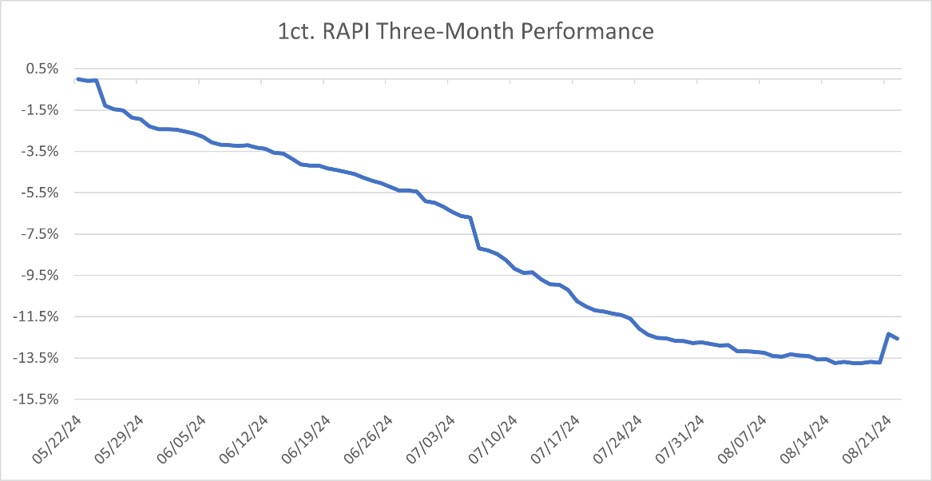
A snapshot on the current market conditions – In the aim to give an image of the current market conditions, the RapNet Diamond Index (RAPI) is the average of the best prices 10 asking princes in each category for Round, D-H, IF-VS2, GIA Graded, Rapaport Specification A3 or better diamonds, which are offered for sale on RapNet-Rapaport Diamond trading Network. While the RAPU indices are available for 0.30 Ct, o.50 Ct, 0.70 Ct, 1.00 Ct, 2.00 Ct, 3.00 carat size categories, the primary index will be for one carat sizes. Rapnet has daily listings of over 1.3m diamonds valued over US$8 billion and 10,000+ members in 89 countries. The RAPI index is available to Rapaport Price List Subscribers weekly. The report listed here refers to the last bulletin, August 2024.
Edited by Prof. Giuseppe G. Santorsola
– Chair in Asset Management
– Corporate Finance and Corporate & Investment Banking
– Professor of Finance Catholic University of Holy Heart – Piacenza