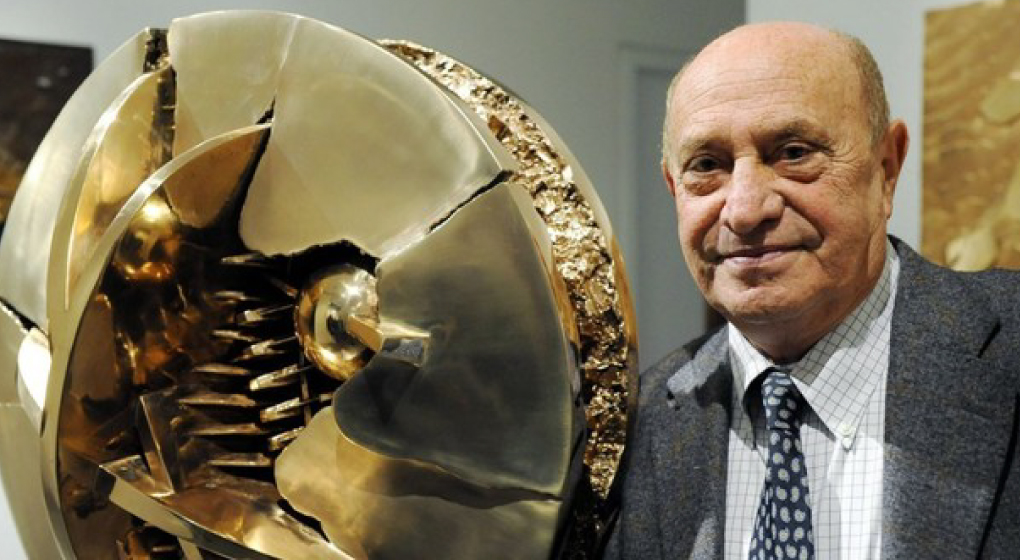
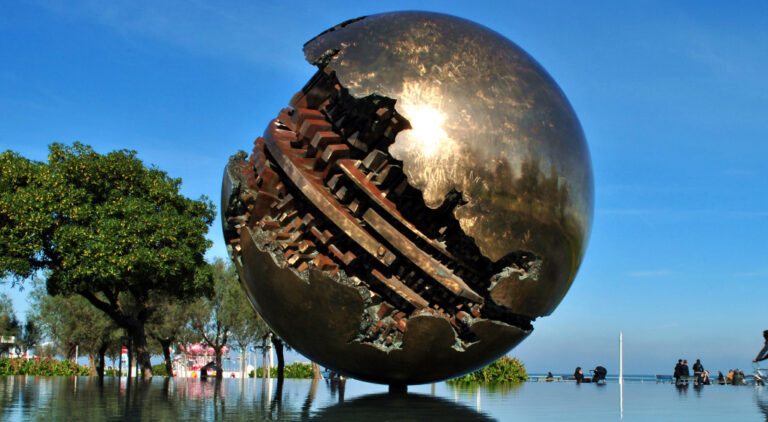
“I see them as relating borders and voyages, to the worlds of complexity and imagination,” Arnaldo Pomodoro says. He thinks of his enormous, architectural sculptures as “nuclei, crystals, as eyes, or as signal fires.” Drawing on Arnaldo Pomodoro’s architecture training, his concerns revolve around the correlation between the individual sculpture and the location or space where it has been installed.
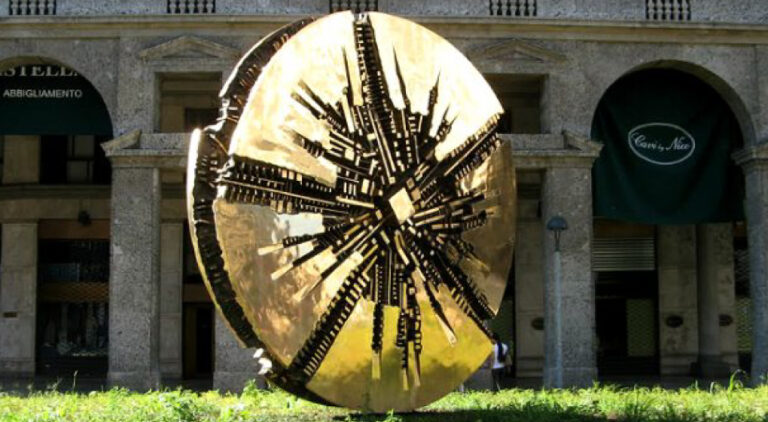
Arnaldo Pomodoro was an Italian who was born in 1926 in Montefeltro. Pesaro is the place where this famous artist spent his childhood and his education. He lives in Milan, and since 1954, he has been working there. His works from the year 1950 are high-reliefs wherein a previously unknown and unique sculptural “writing” has emerged and was interpreted by various important critics. In the following years, during the 60’s, he began three-dimensional work and began to focus his research on the solid geometric forms such as spheres, pyramids, cones, discs, cubes, and columns. These are all burnished bronze, corroded, lacerated, and excavated in depths, together to bring harm to its perfection as well as discover its mystery within. The formal juxtaposition between the chaotic complexity of the insides and the shiny completeness of geometric shapes from then on became constant in his production.
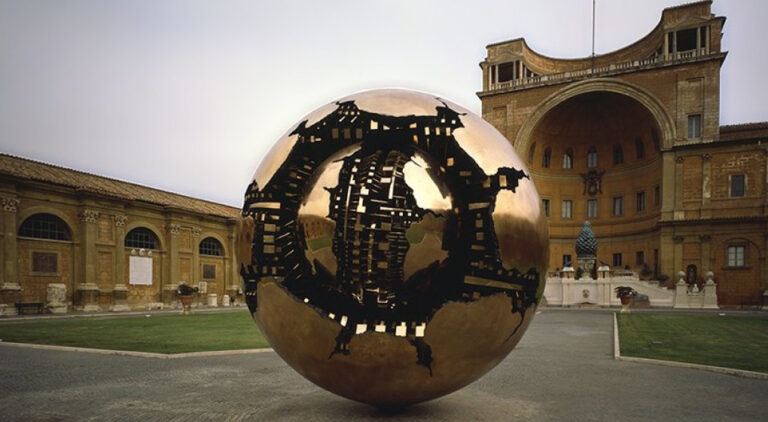
In the year 1966, he was commissioned to make a sphere for the Montreal Expo. This was the very first of several works of Pomodoro placed in important and symbolic public spaces – in several city squares like in Copenhagen, Milan, Los Angeles, Brisbane, Darmstadt, also in front of the College of Trinity, Dublin, California Mills College, Cortile della Pigna located in Vietnam, at the UNESCO headquarters in Paris, and many more. With regards to environmental works, Pomodoro has also participated in projects ranging from the New Cemetery Project of Urbino in 1973, which involved excavating a hill somewhere in Urbino. However, because of disagreements and local issues, this was never built since the wall was a very long concrete covering the Marsala for II Simposio di Minoa through to Sala d’Armi for Museum Poldi Pezzoli in Milan, and Entering the Labyrinth, which was dedicated to the Gilgamesh Epic. Pomodoro completed the Carapace in 2011, which was a wine cellar located in Bevagna, constructed for the Lunelli family.
He dedicated himself to setting design since the beginning of all his activities, and he created the “spectacular machines” for many theatrical works, from the tragedy in Greek to melodrama and from the contemporary theatre into music. He has also taught in the department of arts at various Universities in America, like Stanford University, the University of Berkeley, and Mills College.
Pomodoro received many prestigious awards. To name some: Sculpture Prices at Biennials (1963), Venice (1964), Imperial Premium for Sculpture (1990) at the Art Association in Japan, Lifetime Achievement for the Contemporary Sculpture from the International Sculpture Centre in San Francisco (2008). In 1992, the artist received an honoris causa (Degree in Humanities). In 2001, he got an honorary degree in Architectural Engineering from Ancona University.
Article edited by Alexander Elisab